
The Installer Report
How Much Contamination Is Acceptable in a Window Tint Installation?
There is no universal particle-count spec — but the IWFA’s visual inspection guidelines define what ‘unobtrusive’ means. Here’s how shops should set customer expectations before TikTok becomes the judge.
By : Installer Report Desk
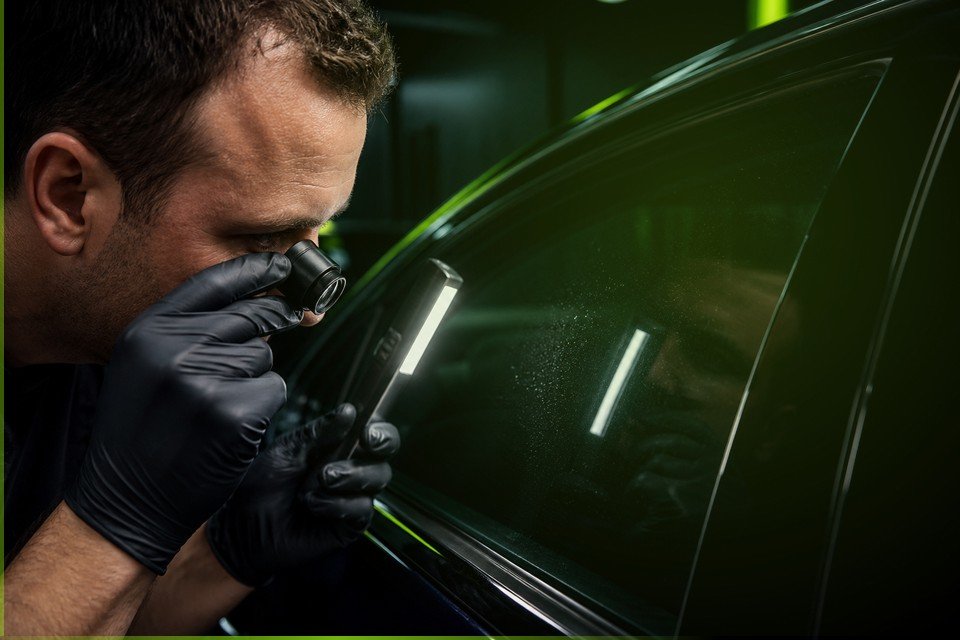
Illustration by Installer Report
A customer posts a macro video of three dust specks under fresh tint. Comments declare the job “unacceptable.” The shop offers a redo; the customer worries a re-pull will tear the defroster lines. Everyone loses time — and the industry still has no single number that says how many particles are OK.
That pattern is playing out in tint forums this week — including r/WindowTint threads on contamination clusters and debates over acceptable specs. Those posts are anecdotal social signal, not standards documents. They still matter because social feeds are now the arbitration layer when written handoffs are weak.
The closest thing to a shared industry reference is the International Window Film Association (IWFA) visual inspection guideline for applied automotive film — adopted industry-wide language manufacturers such as Madico publish to dealers.
Is there a numeric contamination limit?
No universal public standard assigns an allowed count of particles per square inch for automotive tint.
Installer Report found no IWFA, manufacturer, or state inspection rule that publishes a numeric tolerance like “maximum four specks per panel.” If a shop claims “industry standard allows zero defects,” that is marketing — not a cited spec.
What exists instead is a qualitative standard: certain blemish types must be unobtrusive when viewed correctly.
What the IWFA guideline actually says
The IWFA inspection guidelines page and the association’s Automotive Visual Inspection Guideline PDF (linked from that page) establish these principles:
Film is not glass
Installed automotive film is not expected to match the visual quality of raw glass. The criteria apply to the film layer — not defects inherent in the glass itself ( scratches, chips, distortion in the laminate).
Cure-period effects are not defects
Installations use slip solutions; residual moisture is normal. During curing, water haze, water distortion, and water bubbles should not be classified as defects. High-performance films may have longer cure times; manufacturers may specify timelines beyond generic guidance.
Architectural guidance references typical ~30-day visual cure windows in educational materials; automotive inspection can occur within one day of installation for non-cure blemishes — but evaluators must distinguish drying artifacts from embedded contamination.
The “unobtrusive” list
An installation is deemed acceptable if all of the following are unobtrusive (again, disregarding cure effects):
- Dirt particles, hair, and fibers
- Adhesive gels, fingerprints, air bubbles (post-cure)
- Water haze (during cure only)
- Scores and scratches, film distortion, creases
- Edge lift, nicks and tears
Obtrusiveness is judged by looking through the film in natural daylight — not by flash photography at grazing angles that amplify every micro particle.
Edge gaps are normal
The architectural/visual standard documents (widely reproduced in dealer kits) describe normal edge gaps roughly in the 1/32–1/16 inch (1–4 mm) range so water can be squeegeed out and edges are not lifted by frame contact — with slightly wider tolerances on thicker safety films. Edge gaps are not contamination, but customers often film them as “sloppy.”
No formal redo standard
The IWFA document defines acceptance inspection — it does not automatically mandate a free redo threshold. Shop policy, warranty goodwill, and state consumer laws fill that gap.
Inspection conditions that end fights
Most disputes are lighting disputes. Before calling a job defective or perfect:
| Variable | Why it matters | | --- | --- | | Natural daylight | IWFA baseline; garage LEDs lie | | Viewing through the glass | Not reflective glare down the film surface | | Interior vs. exterior angle | Contamination visible inside may be invisible to the driver | | Post-cure timing | Bubble maps on day one ≠ day ten | | Glass condition baseline | Document pre-existing pits and coating |
Shops that skip a 60-second walkthrough in daylight invite a 60-second TikTok review later.
Localized cluster vs. widespread debris
Operator framing that matches the guideline language:
Likely acceptable (if unobtrusive in daylight):
- A small, static cluster not in the primary sightline
- Single fiber when not accompanied by creases or edge lift
- Minor edge gap within normal tolerance bands
Likely correction-worthy:
- Contamination dense enough to read as “dirty glass” at normal seating position
- Creases, fingers, or drag lines from poor technique — not cure haze
- Edge lift or adhesive gel pockets spreading after cure
- Defects concentrated in the driver’s direct forward cone
Redo risk to disclose:
- Re-tinting may disturb defroster lines, dot-matrix frit, or brittle rear glass
- Second pulls increase film cost and bay time — reason to fix only failing panels when possible
Never promise “zero particles.” Promise inspection method and good-faith correction when blemishes are truly obtrusive.
What social threads reveal (not prove)
Recent Reddit WindowTint posts show customers magnifying clusters and asking if shops are “scamming” them when specks remain. Common themes:
- owners lack cure-period education
- shops skip signed acceptance language
- photographers use phone macro lenses that no driver experience replicates
Do not treat comment upvotes as engagement proof of a “viral crisis.” Treat them as a documentation prompt.
Why the industry needs customer-facing standards
Without a shared script:
- good shops eat full re-dos to protect reviews
- mediocre shops hide behind “perfection is impossible”
- customers learn from creators who film for contrast, not clarity
A one-page Visual Inspection & Cure Acknowledgment citing IWFA principles reduces asymmetry. It is not legal advice — it is expectation alignment.
Suggested handoff bullets (paraphrasing IWFA, not replacing the PDF):
- Film may look hazy or show moisture during cure — call the shop before assuming defect.
- Inspection for acceptance uses natural daylight, viewed through the glass.
- Minor unobtrusive particles can occur; clusters in the sightline should be reported promptly.
- Edge gaps are intentional for durability.
- Report creases, edge lift, or spreading bubbles after cure.
What installers should do now
- Print or link the IWFA automotive visual guideline on your delivery iPad flow — iwfa.com/inspection-guidelines.
- Inspect with the customer present in daylight before keys leave the building.
- Photograph wide shots and sightline shots at delivery — not just bay beauty content.
- Separate cure complaints from contamination complaints on your rework ticket taxonomy.
- Define shop rework policy in writing: what you will fix, what requires panel replacement, time limits.
- Train CSRs to refuse macro-video verdicts until daylight re-inspection — politely.
- Push manufacturers / associations for updated consumer-facing summaries — operators should not each reinvent the same PDF translation.
Source note
Primary standard: IWFA — Inspection Guidelines and the Automotive Visual Inspection Guideline for Applied Window Film PDF linked there; dealer republication example: Madico — Visual Quality Inspection Guidelines. Social context (anecdotal): r/WindowTint — cluster of contamination, r/WindowTint — acceptable contamination specs. No numeric universal tolerance was identified in these sources as of August 2026 — qualitative “unobtrusive” language governs.
Related reports
 TintLocal
New York’s 50% VLT Shift: What Tint Installers Need to Know
Assembly Bill A5306 would lower New York’s minimum light-transmittance standard from 70% to 50% on key side and rear glass — but it is not law yet, and DMV inspection guidance still reflects the 70% rule.
 TintGlobal
WFCT Meets Auto Glass Week: Why Tint Shops Can’t Ignore ADAS Anymore
Same San Antonio week, shared registration portal, overlapping skillsets. Ceramic non-metal film, camera zones, and calibration culture are colliding—here’s the operator checklist.
 TintGlobal
Summer 2026 Tint Reality Check: Ceramic, EVs, and ADAS Are Table Stakes
Seasonal demand is still heat-driven, but the winning install this summer is non-metallic ceramic, EV signal-safe, and ADAS-aware. Here’s the field checklist for estimators and lead techs.
Get the weekly briefing operators actually read.